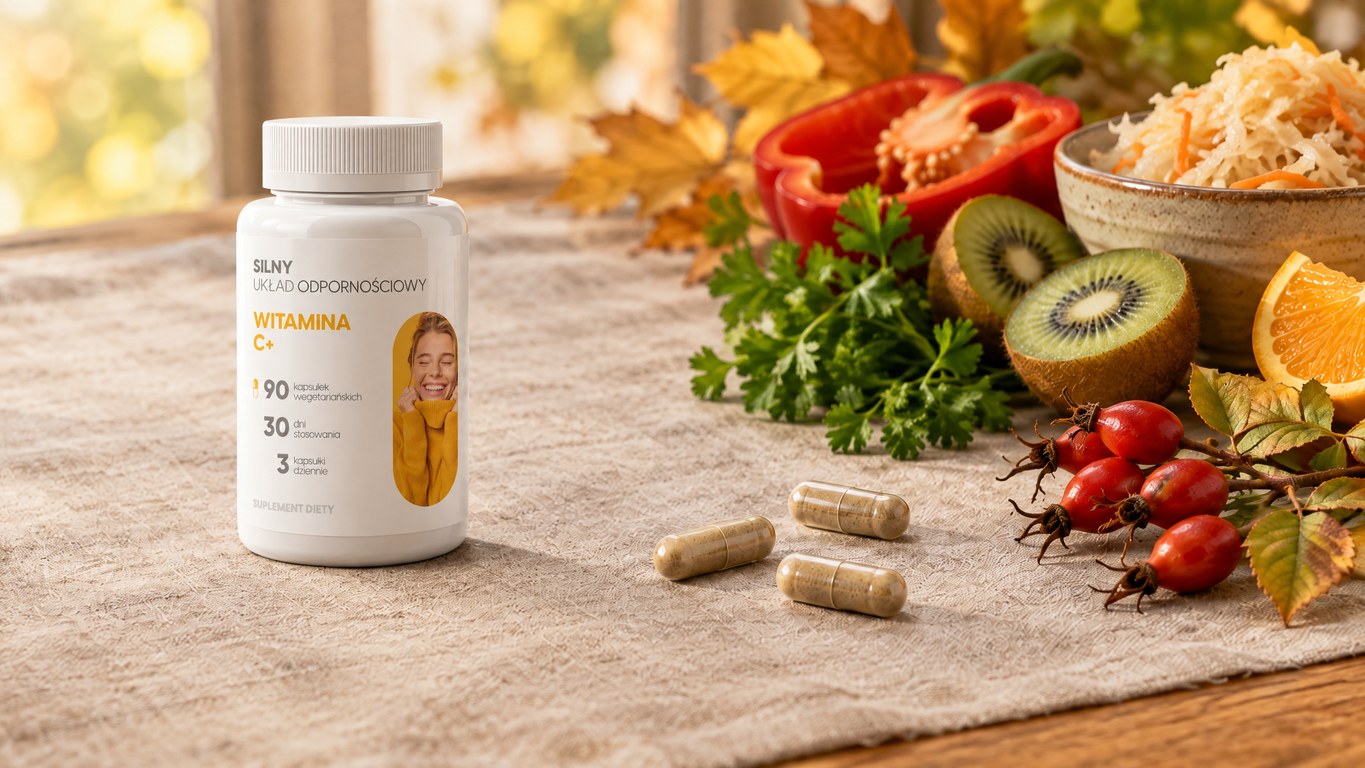
Vitamin C (L-ascorbic acid) is a water-soluble vitamin that the human body cannot make and does not store in large amounts. That is why it has to come regularly from your diet. The nutrient reference value (NRV) for adults is 80 mg a day.
Simple enough - until autumn and winter, when fresh local produce runs short and slow-cooked dishes take over the kitchen. Below: what vitamin C is, where to find it on your plate and how to read a supplement label, so you know how much you actually get.
What vitamin C is
Vitamin C is L-ascorbic acid - a small, water-soluble molecule. The same molecule is found in peppers, kiwi, rosehips and supplements. Chemically there is no "better" or "worse" vitamin C: L-ascorbic acid from fruit and from production is identical.
The differences lie elsewhere: in the form (the pure acid or a salt, such as magnesium ascorbate) and in what comes with it (a whole fruit, a fruit extract or an isolated form).
Why your body cannot make vitamin C
Most animals make vitamin C from glucose. Humans cannot: during evolution our ancestors lost a working enzyme (L-gulonolactone oxidase) needed for the last step of this process. Many primates and the guinea pig share this trait.
Vitamin C is also water-soluble, so the body does not store it like the fat-soluble vitamins A, D, E and K, and excretes the excess in urine. In practice this means you need it every day, not "in advance".
How much vitamin C you need
The nutrient reference value for vitamin C for adults is 80 mg a day. It comes from Regulation (EU) No 1169/2011, and it is what the "% NRV" on food and supplement labels refers to.
The NRV is a labelling reference point, not a personal recommendation. For your individual needs, talk to a doctor or a dietitian.
Where to get vitamin C in your diet
The good news: many good sources are easy to buy all year round:
- vegetables: peppers (especially red ones), parsley, broccoli, Brussels sprouts, cauliflower, kale and cabbage, including sauerkraut,
- fruit: blackcurrants, kiwi, strawberries and citrus fruit,
- less obvious fruit: rosehips, acerola and camu camu, known for their very high vitamin C content.
Vitamin C is sensitive to heat, oxygen and light, and it leaches into cooking water. A few habits help you keep more of it:
- eat some vegetables raw, e.g. peppers, parsley and sauerkraut,
- cook briefly, ideally by steaming or in a small amount of water,
- cut fruit and vegetables just before eating, not hours in advance,
- store them in a cool, dark place and do not keep them too long.
Why it is worth paying attention in autumn and winter
In summer vitamin C almost takes care of itself: strawberries, currants, fresh peppers straight from the garden. In autumn and winter there is less fresh local produce, and much of it has travelled far or spent weeks in storage, during which its vitamin C content gradually drops.
Our habits change too: shorter days favour warm, slow-cooked meals and raw salads disappear from the plate. That makes it a good time to look at what you eat - add peppers, parsley, fermented vegetables or kiwi, and if your diet alone is not enough, consider a supplement.
What the EU register of health claims says about vitamin C
Health claims authorised in Commission Regulation (EU) No 432/2012 describe the role of vitamin C as a nutrient:
- Vitamin C contributes to the normal function of the immune system.
- Vitamin C contributes to the protection of cells from oxidative stress.
- Vitamin C contributes to normal collagen formation for the normal function of blood vessels, bones, cartilage, gums, skin and teeth.
- Vitamin C contributes to the reduction of tiredness and fatigue.
- Vitamin C increases iron absorption.
- Vitamin C contributes to normal functioning of the nervous system.
- Vitamin C contributes to normal psychological function.
- Vitamin C contributes to normal energy-yielding metabolism.
A practical tip: pair plant sources of iron, such as buckwheat or lentils, with vegetables rich in vitamin C.
Standardisation and DER - how to read a label
Labels of plant-extract supplements often show two parameters that describe different things.
Standardisation
Standardisation means that an extract has a defined content of a selected compound. The amount of vitamin C in fruit varies with the variety, ripeness, weather and harvest time. In a standardised extract it is fixed and stated as a percentage.
Example: 750 mg of rosehip fruit extract standardised to 50% vitamin C gives approx. 375 mg of vitamin C. So what counts is not the weight of the extract, but how much vitamin C it delivers.
DER
DER (drug extract ratio) is the ratio of raw material to finished extract. DER 10:1 means that 10 kg of fruit produce 1 kg of extract. It tells you how concentrated the raw material is.
DER does not tell you how much vitamin C the extract contains - that is what standardisation is for. Ideally a label gives both, or at least the total vitamin C per serving.
Five sources of vitamin C in Vitamin C+
We applied these principles to the new Vitamin C+ formula: five sources of vitamin C, each with its amount and standardisation stated. A daily serving of 3 capsules contains:
- rosehip fruit extract (Rosa canina) - 750 mg, standardised to 50% vitamin C, i.e. approx. 375 mg of vitamin C. Wild rose also grows in Poland, and its fruit is picked in autumn,
- magnesium ascorbate - 600 mg, 93% vitamin C, i.e. approx. 558 mg of vitamin C. It is the magnesium salt of ascorbic acid and also provides approx. 39 mg of magnesium (approx. 10% NRV),
- acerola fruit extract (Malpighia emarginata) - 210 mg, standardised to 17% vitamin C, i.e. approx. 36 mg of vitamin C. Acerola comes from Central and South America and is sometimes called the Barbados cherry,
- L-ascorbic acid - 120 mg, i.e. 120 mg of vitamin C in pure form,
- camu camu fruit extract (Myrciaria dubia) - 120 mg, approx. 15% vitamin C, DER 10:1, i.e. approx. 18 mg of vitamin C. Camu camu is a shrub that grows in the Amazon basin.
Together that is approx. 1,107 mg of vitamin C in 3 capsules. The figure is calculated from the standardisation of each raw material, hence "approx.".
Why several sources? The fruit extracts provide vitamin C of plant origin, while magnesium ascorbate and L-ascorbic acid are pure forms that allow the amount per serving to be set precisely. We wanted a formula that is easy to read: you know where every milligram comes from.
One pack: 90 transparent vegetarian capsules (HPMC), i.e. 30 days at 3 capsules a day.
How to use it and what to keep in mind
- 3 capsules a day, preferably with a meal, with water.
- Do not exceed the recommended daily serving. If you take other supplements containing vitamin C, include them in your daily total.
- The product is intended for adults. Not to be used by pregnant or breastfeeding women, or in case of hypersensitivity to any of the ingredients.
- If you take any medication, consult your doctor or pharmacist before adding the supplement.
Key points
- Your body cannot make vitamin C or store much of it, so it needs a daily supply.
- The NRV for vitamin C for adults is 80 mg a day.
- Good dietary sources include peppers, parsley, blackcurrants, kiwi, cabbage-family vegetables and fermented vegetables.
- In autumn and winter, plan vitamin C into your meals more consciously.
- On a supplement label, check the total amount of vitamin C per serving, not just the weight of the extracts.
If you want to top up your diet with vitamin C from several sources at once, have a look at Vitamin C+ - the product page has the full composition and directions for use.
A food supplement should not be used as a substitute for a varied diet and does not replace a healthy lifestyle.
Vida Longa! The Viloway Team
Czy ten artykuł był pomocny?