Potassium is a mineral your body needs every day and in large amounts - for adults EFSA sets 3,500 mg per day. Most potassium comes from vegetables, fruit and pulses. When those foods are rare on your plate, it is easy to fall short. Below we explain how much potassium you need, where to find it and how to read a supplement label.
In short
- EFSA set the adequate intake of potassium for adults at 3,500 mg a day.
- The reference intake (RI) on labels is 2,000 mg - "% RI" refers to it.
- Vegetables, fruit, potatoes, pulses and nuts are the richest sources of potassium.
- Potassium contributes to normal muscle function.
- With kidney disease or certain medicines, a potassium supplement must be discussed with a doctor first.
What potassium is and what it does
Potassium is one of the body's main electrolytes. It sits mainly inside cells and, together with sodium, takes part in signal transmission and muscle work. The body does not store it, and the kidneys excrete any excess. That is why potassium has to be supplied regularly.
What does potassium do? In short:
- Potassium contributes to normal functioning of the nervous system.
- Potassium contributes to normal muscle function.
- Potassium contributes to the maintenance of normal blood pressure.
How much potassium you need
In its 2016 opinion, the European Food Safety Authority (EFSA) set the adequate intake of potassium for adults at 3,500 mg a day. That is a lot - more than many people actually eat, especially when bread, meat and processed foods dominate the diet.
On food and supplement labels you see a different number: the reference intake (RI) of 2,000 mg. It comes from Regulation (EU) No 1169/2011 and is used for labelling only. When a pack says "567 mg (28% RI)", it means 28% of those 2,000 mg.
Where to find potassium on your plate
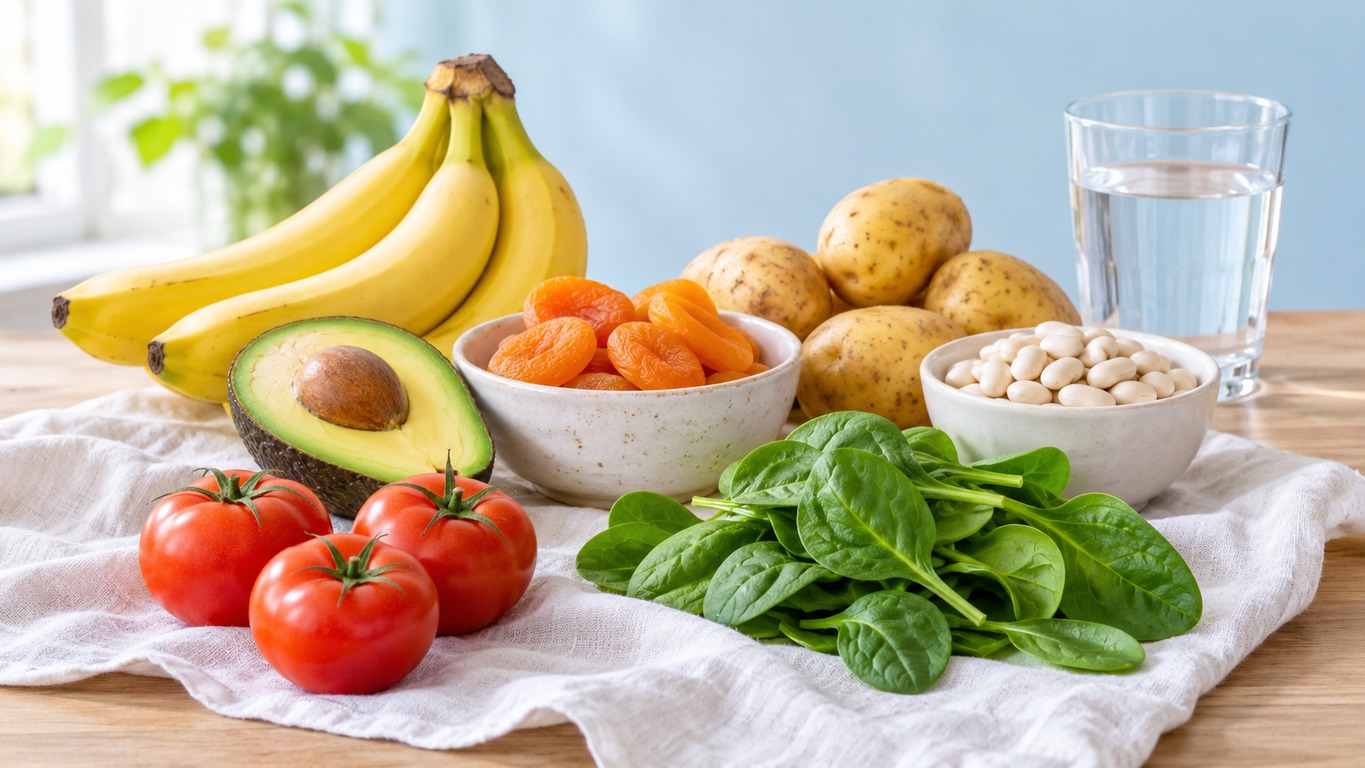
Potassium is found in many everyday foods. It is easiest to get enough when you often eat:
- vegetables: potatoes (ideally boiled in their skins), tomatoes, beetroot, leafy greens such as spinach,
- fruit: bananas, apricots (dried too), avocado, kiwi,
- pulses: beans, lentils, chickpeas,
- nuts and seeds: almonds, pumpkin seeds.
Potassium leaches into the water during cooking. Cook vegetables briefly in little water, or steam them.
Potassium, magnesium and vitamin B6 together
Potassium is often combined with magnesium and vitamin B6, as they complement each other in the daily diet. Magnesium contributes to the reduction of tiredness and fatigue. Magnesium contributes to electrolyte balance. Vitamin B6 contributes to normal functioning of the nervous system. Vitamin B6 contributes to the reduction of tiredness and fatigue.
How to read a potassium supplement label
Before you buy, check three things:
1. How much potassium is in the daily serving
What counts is the amount of potassium itself, not the whole salt. 1,575 mg of potassium citrate contains 567 mg of potassium - and the second number is the one that matters.
2. Which compound the potassium comes from
In supplements potassium usually comes as citrate or chloride. Potassium citrate has a mild taste and works well in capsules.
3. How many capsules a day and how many days the pack lasts
Potassium is heavy per serving, so the daily dose usually takes several capsules. Check how many days the pack lasts - then you know the cost per day.
What to watch out for
The kidneys are mainly responsible for keeping potassium in balance. That is why:
- if you have kidney disease or take blood pressure medication, diuretics or other potassium products, talk to your doctor before you start,
- do not combine several potassium supplements without advice,
- if you also take another supplement with vitamin B6, check your total intake,
- do not exceed the serving stated on the label.
What you get with Potassium + Magnesium + B6
We designed Potassium + Magnesium + B6 around potassium:
- 567 mg of potassium in the daily serving - 28% RI,
- potassium citrate and magnesium citrate - 57 mg magnesium (15% RI) as a complement,
- 3 mg vitamin B6 - 214% RI,
- 3 capsules a day, 30 days from one pack,
- a plant-based HPMC capsule coloured with chlorophyll.
See Potassium + Magnesium + B6 in the shop
Frequently asked questions
How much potassium does an adult need a day?
EFSA set the adequate intake for adults at 3,500 mg a day. Most of it should come from food.
What does 28% RI on the label mean?
The RI for potassium is 2,000 mg. 567 mg of potassium is 28% of that value. The RI is used for food labelling and is not an individual recommendation.
Which foods contain the most potassium?
Vegetables, fruit, potatoes, pulses, nuts and seeds - including bananas, apricots, avocado, beans and lentils.
Who should ask a doctor before taking a potassium supplement?
People with kidney disease and those taking blood pressure medication, diuretics or other potassium products. The product is not intended for pregnant or breastfeeding women.
How do I take Potassium + Magnesium + B6?
3 capsules a day with water. One pack (90 capsules) lasts 30 days. Do not exceed the recommended daily serving.
Can I combine it with another magnesium supplement with vitamin B6?
Check your total vitamin B6 intake from all supplements and, if in doubt, ask a pharmacist or doctor.
Sources
- Commission Regulation (EU) No 432/2012 - list of permitted health claims: EUR-Lex
- EFSA, Dietary reference values for potassium (2016): EFSA Journal 2016;14(10):4592
- Regulation (EU) No 1169/2011 - reference intakes: EUR-Lex
Czy ten artykuł był pomocny?