Berberine is a yellow plant alkaloid from the bark and roots of barberries, including Indian barberry (Berberis aristata). It is one of the most widely described plant compounds in scientific literature. When choosing a product, one question matters most: how much berberine is really in the capsule.
In short
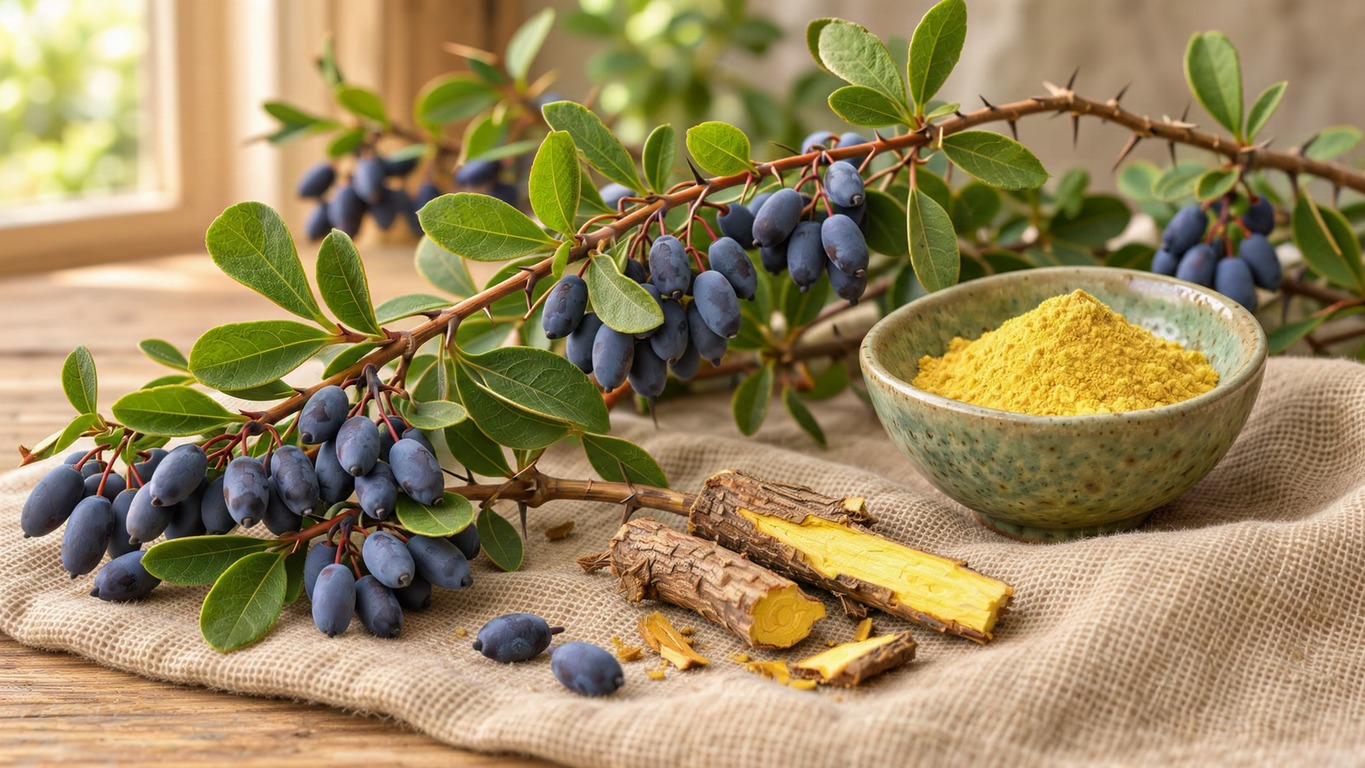
- Berberine gives barberry bark and wood their intense yellow colour. In Ayurveda Indian barberry is called daruharidra, meaning "yellow wood".
- Compare products by berberine content in mg, not by the weight of the extract.
- Standardisation to 97% means 600 mg of extract contains 582 mg of berberine HCl.
- Berberine may affect how some medicines work. If you take medication, start by talking to your doctor.
- In the European Union there are no authorised health claims for berberine.
Where berberine comes from
Indian barberry is a thorny shrub from the Himalayas, India and Nepal. It has leathery, oblong leaves and dark blue berries with a pale bloom. Cut one of its twigs and you will see a bright yellow core. That is the colour of berberine, which the plant stores in its bark and roots.
Berberine is an isoquinoline alkaloid, a small nitrogen-containing molecule that plants produce naturally. It also occurs in goldenseal (Hydrastis) and in the bark of the Amur cork tree, among others. It tastes bitter and, thanks to its colour, has long been used as a dye too. A 2025 review describes the botany and traditional uses of Indian barberry and names berberine as its main compound.
When people reach for berberine
Berberine has for years been one of the most studied plant extracts. Berberine supplements are most often chosen by adults who:
- eat a lot of carbohydrates: bread, pasta, sweets and snacks,
- work sedentary jobs and are sorting out their daily habits,
- work on their figure through diet and exercise,
- after 40 choose more consciously what they eat,
- are changing their eating habits and want a supplement to be a simple part of the new routine.
A food supplement complements the diet, it does not replace it. Meals, movement and sleep always come first.
How to choose a good berberine
There are many berberine products on the market and their labels differ a lot. Before you buy, check three things.
1. How much berberine is in a serving
Some products state only the weight of the extract, e.g. "500 mg barberry extract". Without standardisation you do not know how much berberine it contains. Look for berberine content in mg per daily serving.
2. What the standardisation is
Standardisation is the percentage of active compound in the extract. A simple formula: extract weight x standardisation = berberine content. Example: 600 mg x 97% = 582 mg of berberine.
3. How many capsules a day and how many days the pack lasts
The same amount of berberine can come in one capsule or in three. Also check how many days the pack lasts. Only then do you know the cost per day.
What to watch out for
Scientific reviews describe that berberine may affect liver enzymes that process many medicines (including CYP2D6 and CYP3A4). In practice it may change how some medicines work. That is why:
- if you take any medication regularly, talk to your doctor or pharmacist before you start,
- do not use berberine during pregnancy, breastfeeding or in children,
- do not exceed the serving stated on the label.
What you get with Berberine+
We designed Berberine+ around the same three questions:
- 582 mg berberine in a single capsule - the content stated plainly on the label,
- 97% standardisation - 600 mg of Indian barberry bark extract that is almost pure berberine hydrochloride,
- 1 capsule a day - with a meal, no splitting the serving into several capsules,
- 60 days from one pack,
- a short ingredient list - just the extract, a plant-based HPMC capsule and chlorophyll as colouring.
Frequently asked questions
How does berberine differ from barberry extract?
Barberry extract is a plant extract, and berberine is its main compound. Standardisation tells you how much berberine the extract contains. In an extract standardised to 97%, berberine makes up almost all of it.
What does "berberine hydrochloride" mean?
It is the salt form in which berberine most often appears in supplements. Labels sometimes write it as berberine HCl.
How much berberine is in Berberine+?
582 mg of berberine hydrochloride in a single capsule, which is the daily serving.
Can berberine be combined with medication?
Berberine may affect how some medicines work. If you take medication, decide on use together with your doctor or pharmacist.
Who should not use berberine?
Pregnant women, breastfeeding women and children. Caution also applies to people taking medication regularly.
How do I take Berberine+?
One capsule a day with a meal, with water, ideally at the same time.
Sources
- Review of the botany, composition and traditional uses of Berberis aristata (2025): PubMed 40239774
- Berberine - compound profile: PMC12516553
- Berberine, CYP enzymes and medicines: PMC5507062
Czy ten artykuł był pomocny?